 Jeremy Norman’s
HistoryofInformation.com Exploring the History of Information and Media through Timelines
Jeremy Norman’s

A: Laurel, Maryland, United States
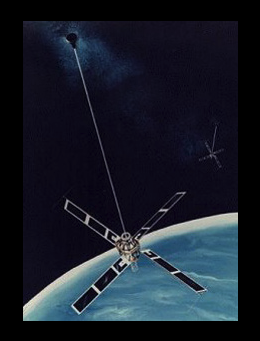
Artist's rendering of the TRANSIT or NAVSAT Satellite Navigation Satellite
On October 4, 1957 the U.S. Navy launched NAVSAT, also known as TRANSIT. NAVSAT was the first operational satellite navigation system.
"The TRANSIT satellite system was developed by the Applied Physics Laboratory (APL) of Johns Hopkins University for the U.S. Navy. Just days after the Soviet launch of Sputnik 1, the first man-made earth-orbiting satellite on October 4, 1957, two physicists at APL, William Guier and George Weiffenbach, found themselves in discussion about the microwave signals that would likely be emanating from the satellite. They were able to determine Sputnik's orbit by analyzing the Doppler shift of its radio signals during a single pass. Frank McClure, the chairman of APL's Research Center, suggested that if the satellite's position were known and predictable, the Doppler shift could be used to locate a receiver on Earth.
"Development of the TRANSIT system began in 1958, and a prototype satellite, Transit 1A, was launched in September 1959. That satellite failed to reach orbit. A second satellite, Transit 1B, was successfully launched April 13, 1960, by a Thor-Ablestar rocket. The first successful tests of the system were made in 1960, and the system entered Naval service in 1964" (Wikipedia article on Transit (satellite), accessed 12-26-2012).
Using a constellation of five satellites, NAVSAT was primarily employed to obtain accurate location information by ballistic missile submarines, and was also used as a general navigation system by the Navy, and in hydrographic and geodetic surveying.
"Since no computer small enough to fit through a submarine's hatch existed (in 1958), a new computer was designed, named the AN/UYK-1. It was built with rounded corners to fit through the hatch and was about five feet tall and sealed to be water-proof. The principal design engineer was then-UCLA-faculty-member Lowell Amdahl, brother of Gene Amdahl. The AN/UYK-1 was built by the Ramo-Wooldridge Corporation (later TRW) for the Lafayette class SSBNs. It was equipped with 8,192 words of 15-bit core memory plus parity bit, threaded by hand at their Canoga Park factory. Cycle time was about one microsecond.
"The AN/UYK-1 was a "micro-programmed" machine with a 15-bit word length that lacked hardware commands to subtract, multiply or divide, but could add, shift, form one's complement, and test the carry bit. Instructions to perform standard fixed and floating point operations were software subroutines and programs were lists of links and operators to those subroutines. For example, the "subtract" subroutine had to form the one's complement of the subtrahend and add it. Multiplication required successive shifting and conditional adding.
"The most interesting feature of the AN/UYK-1 instruction set was that the machine-language instructions had two operators that could simultaneously manipulate the arithmetic registers, for example complementing the contents of one register while loading or storing another. It also may have been the first computer that implemented a single-cycle indirect addressing ability.
"During a satellite pass, a GE receiver would receive the orbital parameters and encrypted messages from the satellite, as well as measure the Doppler shifted frequency at intervals and provide this data to the AN/UYK-1 computer. The computer would also receive from the ship's inertial navigation system (SINS), a reading of latitude and longitude. Using this information the AN/UYK-1 ran the least squares algorithm and provided a location reading in about fifteen minutes" (http://en.wikipedia.org/wiki/Transit_(satellite)#The_AN.2FUYK-1_Computer, accessed 12-01-2013).
