 Jeremy Norman’s
HistoryofInformation.com Exploring the History of Information and Media through Timelines
Jeremy Norman’s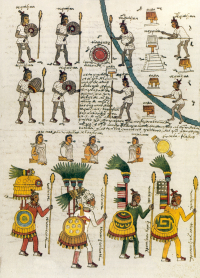
Codex Mendoza f 67r. Top: Warriors scout a town at night in preparation for an attack. Middle: Negotiations after surrender. Bottom: High-ranking commanders.

A: Centro, Ciudad de México, Ciudad de México, Mexico
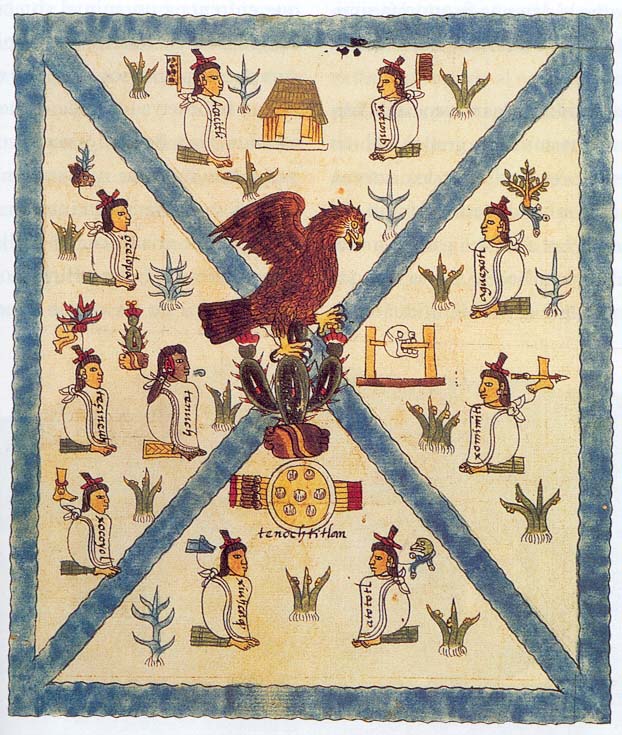
Created about 1540, about twenty years after the Spanish conquest of Mexico (August 13,1521) with the intent that it be seen by Charles V, the Holy Roman Emperor and King of Spain, the Codex Mendoza is an Aztec codex containing a history of the Aztec rulers and their conquests, a list of the tribute paid by the conquered, and a description of daily Aztec life, in traditional Aztec pictograms with Spanish explanations and commentary. The manuscript is preserved in the Bodleian Library, MS. Arch Seld. A.1.
The codex is named after Antonio de Mendoza, the first viceroy of New Spain, who may have commissioned it. It is also known as the Codex Mendocino and La coleccion Mendoza. It is one of a group of ten or more Aztec codices that were created in the first few decades of Spanish rule, and which provide some of the best primary sources for Aztec culture.
Although there are very few surviving pre-conquest codices, the Aztec tlacuilo (codex painter) tradition endured the transition to colonial culture. As a result, scholars have access to a body of around 500 colonial-era codices. These later Colonial-era Nahuatl language documents are the foundational texts of the New Philology, which utilizes these texts to create scholarly works from the indigenous viewpoint.
The Codex Mendoza has an unusually eventful history.
" . . .[It] was hurriedly created in Mexico City, to be sent by ship to Spain. However, the fleet was attacked by French privateers, and codex along with the rest of the booty taken to France. There it came into the possession of André Thévet, French king Henry II's cosmographer, who wrote his name in five places on the codex, twice with the date 1553. It was later bought by the Englishman Richard Hakluyt for 20 French crowns. Sometime after 1616 it was passed to Samuel Purchas, then to his son, and then to John Selden. The codex was finally deposited into the Bodleian Library at Oxford University in 1659, 5 years after Selden's death, where it remained in obscurity until 1831, when it was rediscovered by Viscount Kingsborough and brought to the attention of scholars." (Wikipedia article on Codex Mendoza, accessed 10-22-2014).