 Jeremy Norman’s
HistoryofInformation.com Exploring the History of Information and Media through Timelines
Jeremy Norman’s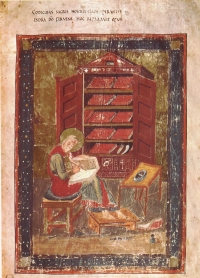

A: Roma, Lazio, Italy, B: Squillace, Calabria, Italy, C: Toscana, Italy, D: Jarrow, England, United Kingdom
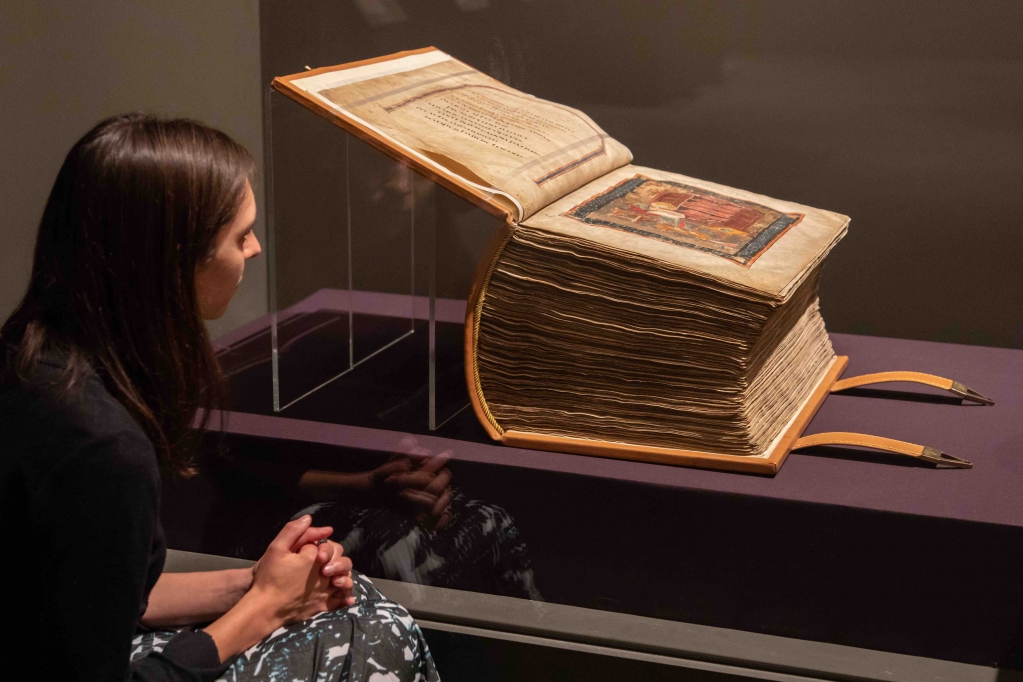
One of the largest and heaviest of all medieval manuscripts, the single volume of the Codex Amiatinus weighs 75 pounds.
About 688 Abbot Ceolfrid (Ceolfrith) of Wearmouth-Jarrow, teacher of Bede, commissioned three complete Bibles of the "new translation" (tres pandectes novae translationis) to be copied at the Wearmouth-Jarrow scriptorium. These pandects resulted from intensive study of the biblical texts directed by Ceolfrid based on the library of Wearmouth-Jarrow, including a pandect of the "old translation" (Jerome's Latin Vulgate) which Ceolfrid had brought back from Rome after one of his two visits there, or which had been brought to Northmbria from Rome in 678 by the founder of the two monasteries, Benedict Biscop. That manuscript is thought to have been a "lost Vivarium manuscript" (M. Davies, "Medieval Libraries" in D. Stam (ed.) International Dictionary of Library Histories, I [2001] 105). This lost manuscript was most probably one of Cassiodorus's Bibles from the Vivarium at Squillace— probably the Codex grandior littera clariore conscriptus. "For centuries it [the Codex Amiatinus] was considered an Italo-Byzantine manuscript, and it was only recognized for its English production about a century ago" (Browne, Painted Labyrinth. The World of the Lindisfarne Gospels [2004] 9).
Two of Ceolfrid's new pandects were placed in each of the twin churches of Wearmouth-Jarrow. However, apart from a fragment known as the Ceolfrid Bible, only the third copy of the huge Bible, which Ceolfrid intended as a gift to the Pope, survived. This huge codex, later known as the Codex Amiatinus, completed by seven (some say nine) different scribes, is the earliest surviving manuscript of the complete Bible in the Latin Vulgate version, and is considered the most accurate copy of St. Jerome's text. It contains "a spectrum of scripts"—formal Uncial, Capituilar Uncial and Rustic Capital. These "furnish paleographical criteria for identifying other manuscripts produced in the scriptorium in the time of Abbot Ceolfrid and his successor Abbot Hwaetberht" (Parkes, The Scriptorium of Wearmouth-Jarrow. Jarrow Lecture,1982, p. 3). (Other manuscripts produced at the scriptorium include the St. Petersburg Bede.)
The frontispiece of the Codex Amiatinus illustrated here shows a saintly figure, presumably the Old Testament prophet Ezra, or possibly Cassiodorus himself characterized as Ezra, writing a manuscript on his lap, and seated before an open book cupboard or armarium which contains a Bible in nine volumes, like the Codex grandior known to have been owned by Cassiodorus. This is one of the earliest surviving images of bookbindings, and also one of the earliest surviving images of an early form of bookcase. Clasps holding the covers of the bindings closed are clearly visible on the fore-edges of the bound manuscripts lying on the shelves—one of the earliest images of this binding feature. In Twelve Centuries of Bookbindings 400-1600 (1979; 57) Paul Needham suggested that the designs on the bookbindings as they are represented in the miniature bear similarities to the designs of early Coptic bookbindings.
To offer the Codex Amiatinus as a present to Pope Gregory II, Abbot Ceolfrid, made the long journey from England to Rome in old age, departing in 716. Though Ceolfrid died on the journey, his associates brought the volume to the Pope as a cultural "ambassador of the English nation." It was used in the revision of the Vulgate by Pope Sixtus V in 1585-90.
One of the largest and heaviest of all medieval manuscripts, the single volume of the Codex Amiatinus weighs 75 pounds. The costs involved in its production were discussed by Richard Gameson in "The Cost of the Codex Amiatinus," Notes & Queries, 39, No. 1 (March 1992) 2-9. I quote from pp. 4-8 (excluding the many valuable footnotes, as usual):
"Measuring c. 505 x 340 mm. (with a written area of 360-75 x 260) and consisting of 1,030 folios, the Codex Amiatinus is a truly gigantic book. Its text, in which the hands of some seven scribes have been distinguished, is written through in stately uncial, two columns to the page, per cola et commata, and must been very time-consuming to produce, even given the efficient subdivision of labour that is apparent in it. Of the other seven extant bible or biblical codex fragments which are of early Anglo-Saxon origin one is written in half uncial, four in minuscule (generally cursive), one in hybrid minuscule, and one partly in hybrid minuscule, partly in half uncial - in each case their writing would have proceeded more quickly than that of Ceolfrith's volumes. The Codex Amiatinus is enhanced with a limited amount of decoration, including as a pictorial frontispiece to the Old Testament the much-reproduced image of the scribe Ezra at work, painstakingly copied from a mediterranean model. The inclusion of purple-stained pages futher underlines the care that was taken over the production and the opulence of its conception, an opulence that was entirely consonant with the exalted functions envisaged for all three volumes. The fact that the appearance and dimensions (480 x 355 mm; written area 360 x 255) of the leaves which remain from the companion volumes are closely comparable to those of Amiatinus suggests that they were in no way inferior to their extant sister.
"What then were the 'overheads' of this project? In the particular circumstances of the Wearmouth-Jarrow scriptorium (wherever that was and however it be construed) during the late seventh and early eighth century, time was always free - in the sense that no one was being paid per hour or per stint - and often of no great consequence: assuming there was no fixed deadline for a project, if the work were not finished this year then there was always next year, and if for some reason a stint could not be accomplished by one scribe, then there was always another. Consequently the manpower required to compile and write the three giant bibles, labour-intensive tasks though they undoubtedly were, cost nothing in real terms. It is the fabric alone that represents quantifiable expense and it is to this that attention has previously been directed and to which we must now turn. In his seminal study of the Codex Amiatinus published in 1967, Rupert Bruce-Mitford set out some basic data concerning the material that was required to make Ceolfrith's three bibles - data which has been quoted in suitably awed tones ever since - and there seems no reason to quibble with his statistics. Altogether the three volumes are likely to have consisted of some 1,545 bifolia of calf-skin. Now, since in order to obtain unblemished parchment sheets of c. 1010 x 680 mm one would require a new animal skin for each, making no allowance for wastage this represents the pelts of 1,545 calves. This is indeed a large number of animals and Bruce-Mitford rightly concluded that 'only rich and well-run communities could afford to produce books of this calibre'. Yet whether it necessarily implies the existence of great herds of cattle as he also surmised is not so clear, as we shall see; and it is worth pondering in more detail what sort of expense, and hence what sort of riches, it actually represented.
"Before addressing this question directly, however, we should consider the case of Ceolfrith's bibles in a broader historical perspective. It is worth pointing out that, although as has been emphasized, the creation of the three pandects was an exceptionally ambitious undertaking, it is unlikely that the twin foundation's need of skins for parchment dropped substantially during the following century; indeed given the obligation to meet the international demand for copies of the numerous works of their prolific house author, Bede, quite the reverse may well have been the case. In comparison with the Codex Amiatinus, the eighth-century Wearmouth-Jarrow copies of Bede's Historia Eccleiastica which are now in Leningrad and London are small and modestly conceived. Both are economically written in Anglo-Saxon minscule, decoration being confined to a minimum; the former consists of 162 folios, 270 x 190 mm. in size, the latter (in its fire-damaged shrunken state) of 200 folios, measuring 236 x 170 mm. In both these cases at least two and possibly more bifolia could be obtained from a single skin; but even so it is unlikely that fewer than thirty animals would have been needed to make each book. Not much less would have been required for the eighth-century Wearmouth-Jarrow copy of Bede, In Proverbia Salomonis, which is preserved in the Bodleian Library. Clearly to transcribe even a single copy of each of the nearly forty items on the list of works composed by Bede which he appended to the final book of his Historia Ecclesiastica would presuppose the pelt of several substantial herds; and far from confining themselves to single copies, the community seems to have been beleagured with requests for these texts from home and abroad. We may safely conclude that the Codex Amiatinus does not represent the peak of Wearmouth-Jarrow's parchment needs; rather it stands at the beginning of a period of consistently high if not higher consumption. The crucial point is that whatever the cost of the material of Ceolfrith's great project, the community continued to bear equivalent, if not greater 'publishing' expensives in the following generation.
"As our ignorance concerning the actual number of books written at a given Anglo-Saxon foundation in a particular year is equalled by our lack of knowledge about contemporary herd sizes, it is impossible to assess the economic implications of the need for skins for making books except in very general terms. It is evident that by 700 there must have been a much greater demand for this commodity in certain areas of the country than had been the case a century earlier; on the other hand, the imposition that this new use of skins represented (and hence its relative cost) should not be overestimated. In the case of Ceolfrith's bibles there are five considerations which suggest that the outlay reflected in the 1,545 calf-skins was not actually as formidable as the naked statistic of their number alone might seem to suggest.
"In the first place, the fact that Benedict Biscop had managed to equip his twin foundation with a large book collection acquired en masse from Rome, meant that at the end of the seventh century Wearmouth-Jarrow had less need than other ascendant or aspirant intellectual centres to copy texts for its library. Consequently it could more readily afford to deploy its resources in the production of monumental, and newly edited, deluxe volumes elegantly written in uncial letters. The cost of the Codex Amiatinus must be considered in relation to the singular circumstances of a house whose foundation endowment favoured the growth of a scriptorium which was specifically geared to the production of a modest number of high quality books.
"The use of a time-consuming script and the fact that the Codex Amiatinus as a whole was patently the product of painstaking workmanship alerts us to the second point, namely that progress on the project is likely to have been slow. Consequently, the slaughter of the 1,545 calves whose hides became the parchment of the three bibles was not a single act of preparation: on the contrary it represents the accumulation of an uncertain but undoubtedly considerable number of years. if as is not impossible, the project were initiated soon after Ceolfrith became sole abbot of the twin community in 688, while his decision to depart for Rome in 716 reflects the final completion of the presentation volume, then we have a potential working period of some twenty-eight years. Dividing the total of skins accordingly, we are left with an average annual requirement of fifty-five or so - hardly large herd. Now of course we do not know over how many seasons the project actually stretched and this is probably the maximum extreme; yet even if the work were accomplished from start to finish within a decade, which perhaps a not unreasonable estimate, the average annual requirement of skins is still only one hundred and sixty five.
"Thirdly, we should remember that these slaughtered calves did not just provide vellum: they also represented a very considerable number of hot dinners for someone! And once the flesh had been eaten and the hide taken for vellum, the carcasses could still make many other contributions to society - the horns might be used as receptacles (to hold ink amongst other things) or be carved into spoons, the hooves and head could be boiled to make glue, the bones might be worked into any number of items such as combs and pins, or could be ground, mixed with dried blood and used as fertilizer, and so on. As each slaughtered animal provided very much more than just a pelt, the value of the parchment cannot simply be equated with the bare number of beasts it represents. The number of animals that were required for a book can of course be used to indicate its relative expense (showing that the Codex Amiatinus consumed at least seventeen times more resources than the Leningrad Bede for example), but it must be stressed that the absolute cost of the parchment in question was considerably less than the value of this total of animals.
"Fourthly, there is no reason to assume that Wearmouth-Jarrow itself (or any other young Christian establishment for that matter) was solely responsible for raising a sufficient number of animals to supply its parchment needs. Monastic animal husbandry, such as is alluded to in Bede's account of the Abbot Eosterwine of Wearmouth, no doubt accounted for some of the skins that were used, but equally many, if not the majority, were probably acquired as tithes from the surrounding lands. When kings and nobles granted estates to the new communities, in many cases they were simply tranferring to the religious house the ownership of, and hence the right to tithes of produce from, farmsteads that continued to be run by their existing tenants. The traditional occupants now merely owed their dues to the church rather than to a secular lord. The Laws of Ine (688 x 94) c. 70.1 enumerates a lengthy list of produce and livestock as the 'food rent' which is due from an estate of ten hides. We are ill informed about the details of such arrangements, but clearly organizing the annual supply of payments in kind from rent-owning properties was crucially important for the economic well-being of religious foundations. Equally clearly if these rights were to be used to underwrite the production of parchment, a purpose for which they were surely invaluable, measures must have been taken first to commute the dues to a relevant form and then to ensure the delivery of young beasts with suitable pelts. The latter is an issue to which we shall return. The key point to stress here is that the parchment consumption of Wearmouth-Jarrow should be considered in relation to the fact that by 716 the joint community had acquired the right to use the resources of an estate which consisted of at least 150 hides of land (the living of 150 families) - a considerable amount and undoubtedly a very useful and versatile resource.
"Finally, we should remember that is likely to have been standard farming practice at the time to reduce stock at the approach of winter rather than to try to carry all the herd or flock through (a point indirectly reflected in the Old English name for November, blothmonao, and one which receives pictorial commemoration in the scenes of slaughter that habitually illustrate this month in the calendars of later medieval manuscripts). Thus many calves were probably killed at this time, if not shortly after birth. Sucessful Anglo-Saxon animal husbandry implied, quite simply, a high annual slaughter rate. Clearly, then, the need to secure skins to make parchment could easily be integrated into the existing patterns of livestock farming and extensive usage of animal products. This is an important point; and as England's climate is and was generally well-suited to successful animal husbandry, it is unlikely that the need for parchment in the quantities in question placed any strain upon livestock and farming resources (or for that matter represented inconvenient competiton for raw materials to the tanning 'industry'). The fact that not one of the extant Anglo-Saxon manuscripts or fragments produced before c.800 is a palimpsest, although principally to be seen in relation to the circumstance that the leaves which are likely to have been available for re-cycling at this time would themselves have belonged to relevant, modern acquisitions in the Christian period, still perhaps provides some limited independent confirmation of the ready availability of skins for parchment in seventh- and eighth-century England. Parchment, we may conclude is likely to have been a valued and valuable but not essentially expensive commodity (a crucial distinction) in early Christian Anglo-Saxon England, and was certainly not one that would have been difficult to obtain. The amout of it that was actually required year by year to make Ceolfrith's three bibles was not especially great, as we have seen, particularly when considered in relation to Wearmouth-Jarrow's extensive resources. . . . "
The manuscript, long kept in the abbey of Monte Amiata, Abbadia San Salvatore in Tuscany, from which its name is derived, is preserved in the Laurentian Library (Bibliotheca Medicea Laurenziana) in Florence.
Alexander, Insular Manuscripts 6th to 9th Century (1978) No. 7.
ABBOTS OF WEARMOUTH AND JARROW. Bede's Homily i. 13 on Benedict Biscop. Bede's History of the Abbots of Wearmouth and Jarrow. The Anonymous Life of Ceolfrith. Bede's Letter to Ecgbert, Bishop of York. Edited and Translated by Christopher Grocock and I. N. Wood (2013).
(This entry was last revised on 08-24-2014.)

