 Jeremy Norman’s
HistoryofInformation.com Exploring the History of Information and Media through Timelines
Jeremy Norman’s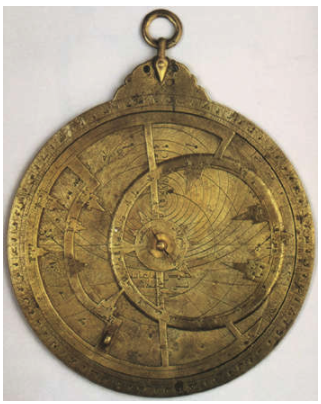
In September 2020 I had to repost this image from my own website because I could no longer find any information or images concerning this astrolabe on the web.
The astrolabe, a type of analog calculator, and an astronomical instrument used for observing planetary movements, was indispensable for navigation. Brass astrolabes were developed in the medieval Islamic world, and were also used to determine the location of the Kaaba in Mecca, in which direction all Muslims face during prayer. Planispheric, or flat, astrolabes, were more common than the linear or spherical types. In planispheric astrolabes the celestial sphere was drawn on a flat surface and represented on one plate.
The earliest known dated astrolabe is of the planispheric type. Made of cast bronze, it bears the name of its maker. The inscription at the back of the kursi, or throne, is written in Kufic , the oldest calligraphic form of the various Arabic scripts, and states that the astrolabe was made by Nastulus (or Bastulus) and gives the date, which corresponds to 927/928. The date is rendered in Arabic letters, whose numerical values total 315, signifying the year in the Islamic calendar in which the astrolabe was made. It is preserved in the School of Oriental and African Studies at the University of London.
NOTE: When I originally wrote this entry, probably around 2010, this astrolabe was considered the earliest surviving example. However, when I returned to the entry in September 2020 I did not find further information available on this particular astrolabe beyond what I had written myself, leading me to wonder whether the date or authenticity of this astrolabe was in question.