 Jeremy Norman’s
HistoryofInformation.com Exploring the History of Information and Media through Timelines
Jeremy Norman’s

A: San Francisco, California, United States
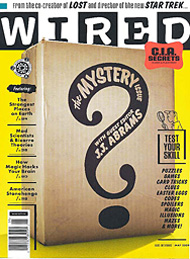
Chris Anderson published "The Long Tail" in the October 2004 issue of Wired magazine. In this article he described "the niche strategy of businesses, such as Amazon.com or Netflix, that sell a large number of unique items, each in relatively small quantities. Anderson elaborated the Long Tail concept in his book The Long Tail: Why the Future of Business Is Selling Less of More.
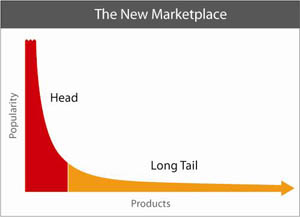
"A frequency distribution with a long tail—the concept at the root of Anderson's coinage—has been studied by statisticians since at least 1946. The distribution and inventory costs of these businesses allow them to realize significant profit out of selling small volumes of hard-to-find items to many customers, instead of only selling large volumes of a reduced number of popular items. The group that purchases a large number of "non-hit" items is the demographic called the Long Tail.
"Given a large enough availability of choice, a large population of customers, and negligible stocking and distribution costs, the selection and buying pattern of the population results in a power law distribution curve, or Pareto distribution. This suggests that a market with a high freedom of choice will create a certain degree of inequality by favoring the upper 20% of the items ("hits" or "head") against the other 80% ("non-hits" or "long tail"). This is known as the Pareto principle or 80–20 rule.
"The Long Tail concept has found a broad ground for application, research and experimentation. It is a common term in online business and the mass media, but also of importance in micro-finance (Grameen Bank, for example), user-driven innovation (Eric von Hippel), social network mechanisms (e.g., crowdsourcing, crowdcasting, Peer-to-peer), economic models, and marketing (viral marketing)" (Wikipedia article on The Long Tail, accessed 04-19-2009).