 Jeremy Norman’s
HistoryofInformation.com Exploring the History of Information and Media through Timelines
Jeremy Norman’s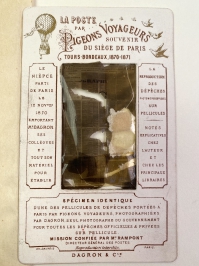
 Jeremy Norman Collection of Images - Creative Commons
 Jeremy Norman Collection of Images - Creative Commons
 Jeremy Norman Collection of Images - Creative Commons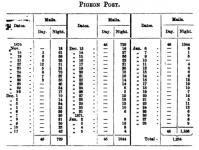
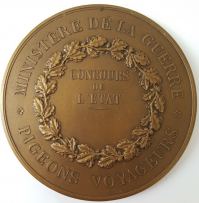
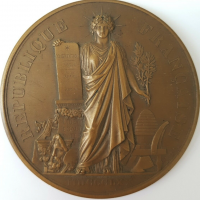
Medal issued by the French government commemorating the pigeon post used during the seige of Paris in 1870.
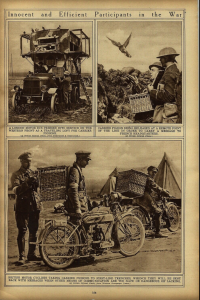
Pigeons being used to carry messages during World War I.
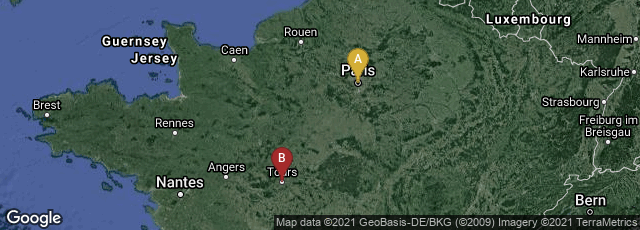
A: Paris, Île-de-France, France, B: Tours, Centre-Val de Loire, France
 Jeremy Norman Collection of Images - Creative Commons
During the four and a half months, from September 19, 1870 to January 28, 1871, of the Siege of Paris by German armies in the Franco-Prussian War normal channels of communication were interrupted, and the only way for the provincial government in Tours to communicate with Paris was by pigeon post.
During this crisis French photographer and inventor of microfilm René Dagron proposed using his microfilming process to carry messages by carrier pigeons. Dagron was not the first to produce microfilms, examples of which were shown by John Benjamin Dancer during the 1850s. The process was sufficiently well known that on July 9, 1853 John F. W. Herschel published a letter in the Athenaeum suggesting the microfilming of "reference materials."
A shortcoming of Dancer's process was that it required a microscope to view the microphotographs, and microscopes were expensive. In 1857 Dagron solved the problem by inventing a method of mounting the microphotographs at the end of a small cylindrical lens. Dagron modified the Stanhope lens by sectioning the normally biconvex Stanhope lens and introducing a planar section so that the plane was located at the focal length of the convex side of the cylindrical lens.[2][7] This produced a plano-convex lens, where Dagron was able to mount the microscopic photograph on the flat side of the lens using Canada balsam as adhesive.[2][7] This arrangement enabled the picture to be focused.
In 1860 Dagron obtained the patent for his viewers under the title Bijoux Photomicroscopiques.[3] Dagron also developed mail order marketing techniques for his viewers, which became a very popular kind of "parlor game."[10] In 1862 Dagron published a small book on these products entitled Cylindres photo-microscopiques, montés et non montés sur bijoux.Two years later, in 1864, Dagron published a small illustrated booklet of 36 pages in 12mo entitled Traité de photographie microscopique giving details of his process, and a price list of his equipment and supplies. This was the first treatise on microfilming techniques
Recognizing that Dagron's established microphotography business would be a viable communication solution, during the Siege Rampont, the man in charge of the carrier pigeon program, agreed to Dagron's proposal, and a contract was signed on November 11, 1870.
"According to the contract Dagron was to be paid 15 francs per 1000 characters photographed. A clause in the contract, signed by an official named Picard, gave Dagron the title of "chief of the photomicroscopic correspondence postal service" mentioning in French: 'M. Dagron a le titre de chef de service des correspondences postales photomicroscopiques. Il relève directement du Directeur Général des Postes,' which translates as 'Mr. Dagron has the title of the chief of the photomicroscopic correspondence postal service. He reports directly to the Director General of the Post Office.'
"After a period of difficulties and through hardships brought on by the war and the lack of equipment, Dagron finally achieved a photographic reduction of more than 40 diameters. The microfilms so produced weighed approximately 0.05 grams each and a pigeon was able to carry up to 20 at a time. Up to that point a page of a message could be copied in a microfilm approximately measuring 37 mm by 23 mm but Dagron was able to reduce this to a size of approximately 11 mm by 6 mm which was a significant reduction in the area of the microphotograph.
"Dagron photographed pages of newspapers in their entirety which he then converted into miniature photographs. He subsequently removed the collodion film from the glass base and rolled it tightly into a cylindrical shape which he then inserted into miniature tubes that were transported fastened on the wings of pigeons. Upon receipt the microphotograph was reattached to a glass frame and was then projected by magic lantern on the wall. The message contained in the microfilm could then be transcribed or copied. By 28 January 1871, when Paris and the Government of National Defense surrendered, Dagron had delivered 115,000 messages to Paris by carrier pigeon" (Wikipedia article on René Dagron, accessed 04-26-2009).
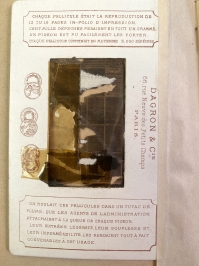
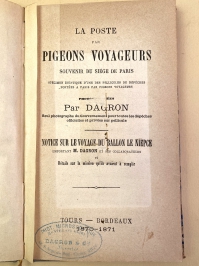
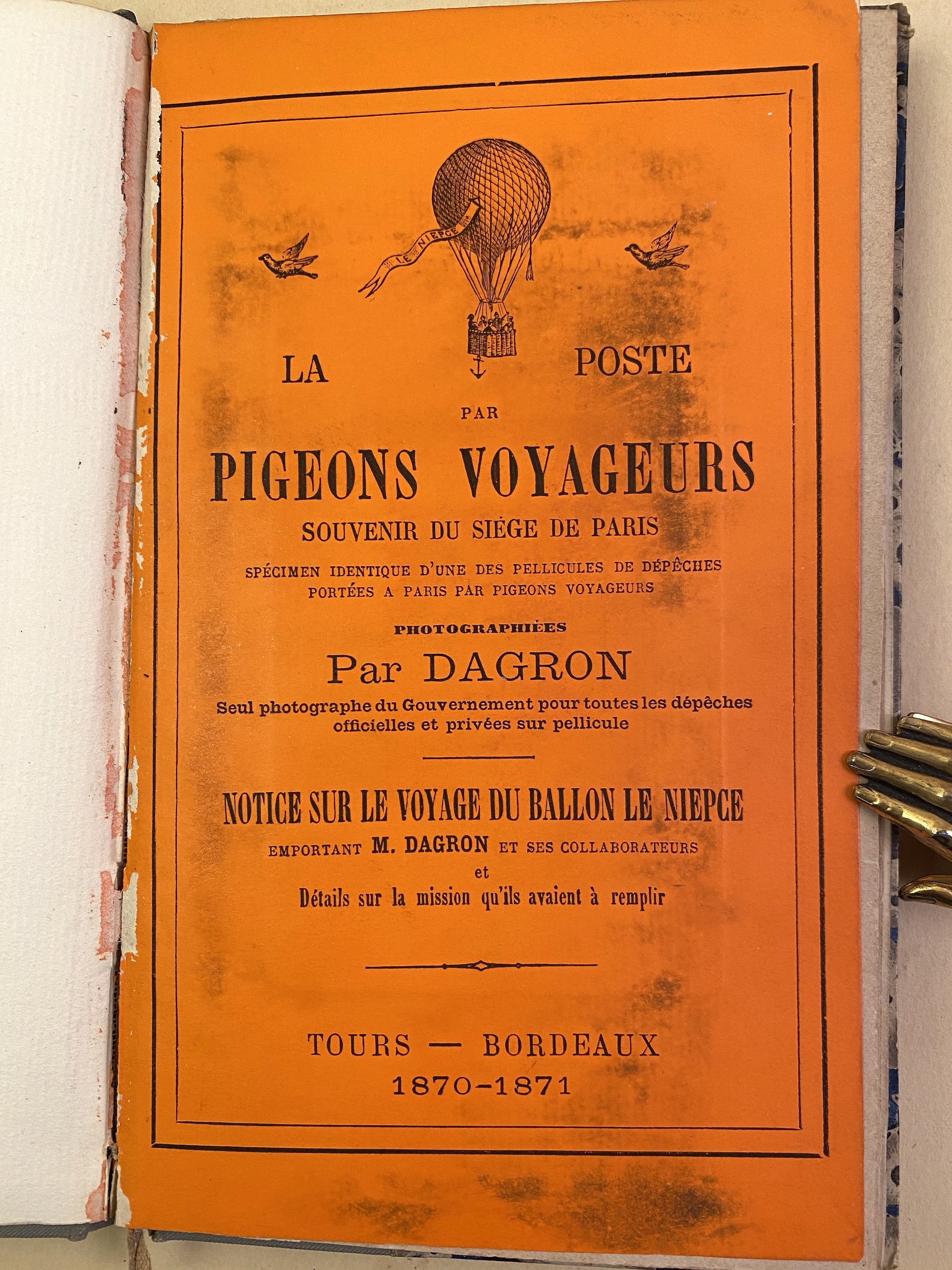
After the seige was over Dagron issued from Paris in 1871 a small 24-page pamphlet in 12mo format describing the achievements of the Pigeon Post, La poste par pigeons voyageurs. Souvenir du Siège du Paris. Spécimen identique d'une des pellicules de dépêches portées a Paris par pigeons voyageurs. When issued the pamphlets contained actual samples of two pieces of microfilm presented in a glassine envelope inserted in a small printed folder inside the pamphlet. Most of the surviving copies of the pamphlet no longer contain the microfilms.
The Seventeenth Report of the Postmaster General on the Post Office (London, 1871) summarized the British experience this way (pp. 6-7):
As to the means adopted for maintaining communication with Paris, the Pigeon Post has become matter of history. Letters intended for this novel mode of transmission had to be sent to the head quarters of the French Post Office at Tours, where, it is understood, they were all copied in consecutive order, and by a process of photography transferred in a wonderfully reduce dform to a diminutive piece of very think paper such as a pigeon could carry, the photographic process being repeated on their arrival in Paris for the purpose of obtaining a larger impression. They were essential conditions that these letters should be posted open without cover or envelope, and that they should be registered; that they should be restricted to 20 words; that they should be written in French inc lear and intelligible language, and that should relate soley to private affairs and contain no allusion either to the war or to politics. The charge was fixed at 5d for each word (the name and address counting as one word and 6d for registration."
J. D. Hayhurst, The Pigeon Post into Paris 1870-1871(1970) provides a comprehensive account, and reproduces a number of original documents including photomicrographs.