 Jeremy Norman’s
HistoryofInformation.com Exploring the History of Information and Media through Timelines
Jeremy Norman’s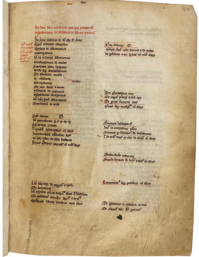
Catalogue of the manuscripts of the library of the Sorbonne in 1338, Paris, BnF, MS NAL 99, p. 237.

A: Paris, Île-de-France, France
The library of the Université de Paris, (also known as the Sorbonne), was organized during this year into two collections: the magna libraria in which the most frequently used books were chained and made available for general use for teaching and course work, and the parva libraria which contained duplicates, and more specialized works needed for research. The library, which was one of the best in Europe, included 1017 books in 1289.
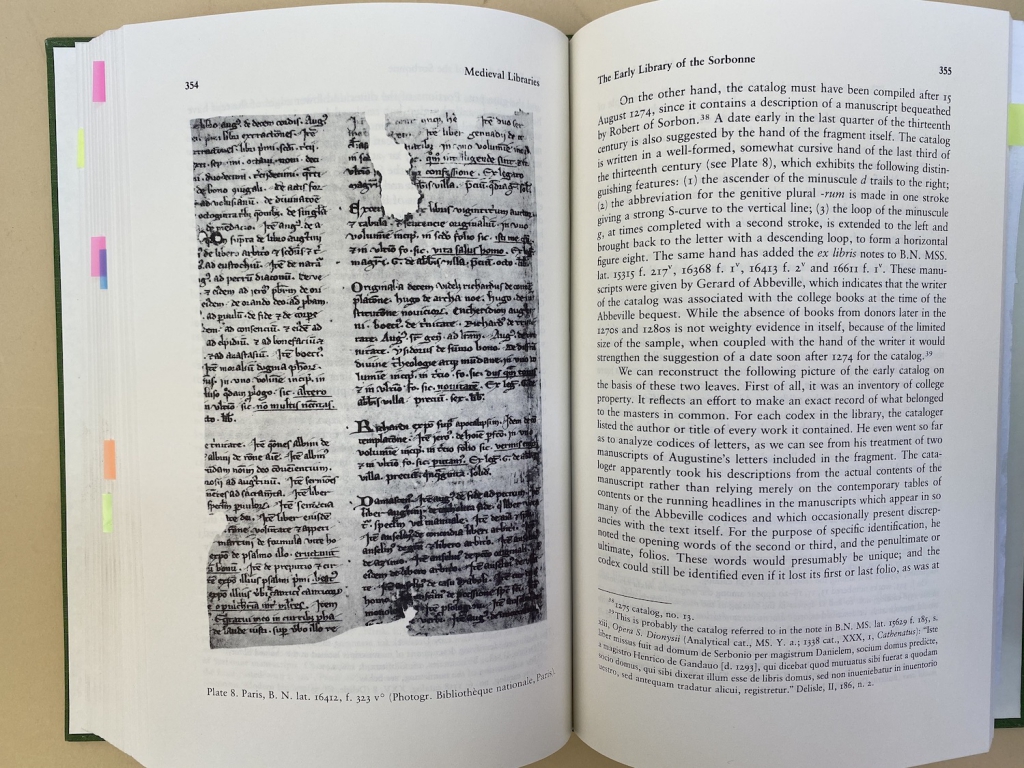
This information comes from a catalogue of the library written in 1338 which incorporated a catalogue of the library written in 1290, of which only two leaves partially survived as pastedowns.
Bischoff, Latin Palaeography: Antiquity and Middle Ages (1990) 226 states that the library of the Sorbonne contained 1722 volumes of manuscripts in 1328. Since many of these volumes contained more than one text, the total number of texts involved would have been substantially higher. According to some accounts, libraries in Moorish Spain or Al-Andalus, especially in Cordoba, may have contained far larger numbers of manuscripts.
"The importance of the establishment of a chained library, in the broader picture, is that it established a place where books were not merely kept but where they were used, and used in common. This change at the Sorbonne in 1289-92 is part of a general trend to divide collections, which appears in Europe at the end of the thirteenth and continues through the fourteenth century. Institutions began to divide their collections by causing certain commonly used works to be chained so that these would always be available to their members, while at the same time continuing to provide for the individual needs of their members and outsiders through a circulating collection. The Sorbonne probably provides the earliest clear example of this change taking place" (Rouse & Rouse, "The Early Library of the Sorbonne," Authentic Witnesses: Approaches to Medieval Texts and Manuscripts [1991] 364, and 343, 352, reproducing a leaf of the 1290 catalogue as plate 8).