 Jeremy Norman’s
HistoryofInformation.com Exploring the History of Information and Media through Timelines
Jeremy Norman’s

A: Paris, Île-de-France, France
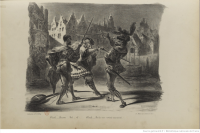
Faust, Tragédie M. de Goethe, Traduite en Français par M. Albert Stapfer, illustrated by French romantic artist Eugène Delacroix, and published in 1828 in Paris by Ch. Motte and Sautelet, is usually considered the first livre d'artiste. It contained a frontispiece portrait of Goethe and 17 lithographed plates drawn on stone by Delacroix. This was one of the major art books illustrated by lithography and the beginning of the French tradition of the painter-lithographer, with the artist preparing his own images on stone for the press.
Though the edition met initially with a hostile reception because of the free, fantastic style of the images, Goethe appreciated their power, writing to Eckermann after he had seen some of the lithographs in November, 1826:
"One must acknowledge that this M. Delacroix has a great talent, which in Faust has found its true nourishment. The French public reproach him for an excess of savage force, but, actually, here it is perfectly suitable . . . If I have to agree that M. Delacroix has surpassed the scenes my writing has conjured up in my own imagination, how much more will readers of the book find his compositions full of reality, and passing beyond the imagery which they envision?" (translation in Ray, The Art of the French Illustrated Book 1700-1914 [1982] No. 143, p. 208).
Concerning the images Delacroix later remarked:
"The peculiar character of the illustrations themselves invited caricature and confirmed my reputation as one of the leaders of the school of ugliness. Gérare, however, although an academician, complimented me on some of the drawings, particularly that of the tavern" (translation in Breon Mitchell, The Complete Illustrations from Delacroix's "Faust" and Manet's "The Raven" [1981] vii.)
(This entry was last revised on 05-20-2014).