 Jeremy Norman’s
HistoryofInformation.com Exploring the History of Information and Media through Timelines
Jeremy Norman’s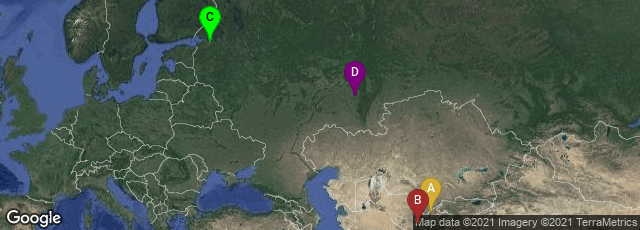
A: Чилонзор тумани, Тошкент, Uzbekistan, B: Samarqand, Samarqand viloyati, Uzbekistan, C: Tsentralnyy rayon, Sankt-Peterburg, Russia, D: Ufa, Respublika Bashkortostan, Russia
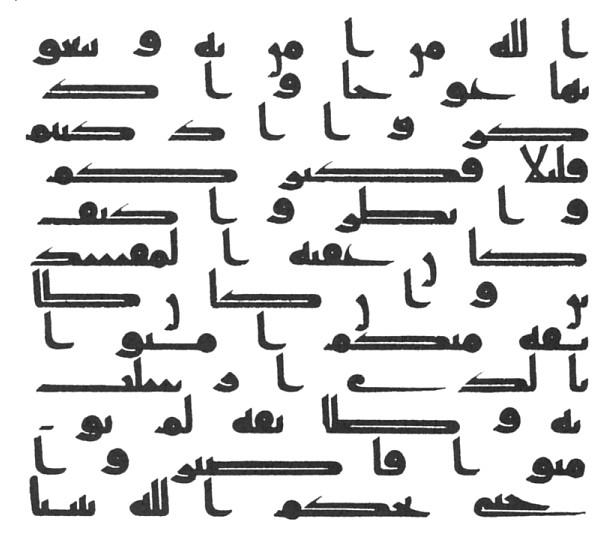
The Uthman Quran (Samarkand Kufic Quran), Sura 7 (Ala'araf), verses 86 and 87.
The Samarkand Kufic Qur'an (also termed the Othmanic codex, Othmanic recension, Samarkand codex, Samarkand Kufic Qu'ran, Samarkand manuscript and Tashkent Qur'an), named for the third Caliph, Uthman ibn Affan, is a manuscript Qur'an (Koran) preserved in the library of the Telyashayakh Mosque, in the old "Hast-Imam" (Khazrati Imom) area of Taskent, Uzbekistan. It is believed to be one of the original five manuscripts of the Qur'an commissioned by Uthman in order to standardize the text. Only one-third of the manuscript survived, beginning in the middle of verse 7 of the second sura and ending abruptly at Surah 43:10. The manuscript has between eight and twelve lines to the page, and is devoid of vocalization.
Dating of the manuscript varies widely. "Based on orthographic and palaeographic studies, the manuscript probably dates from the 8th or 9th century.[2][3] Radio-carbon dating showed a 95.4% probability of a date between 775 and 995.[3] However, one of the folios from another manuscript (held in the Religious Administration of Muslims in Tashkent) was dated to between 595 and 855 A.D. with a likelihood of 95%.[3]"
"Uthman was succeeded by Ali, who took the Uthman Qur'an to Kufa, now in Iraq. When Tamerlane destroyed the area, he took the Qur'an to his capital, Samarkand, as a treasure. It remained there for four centuries until, in 1868, when the Russians invaded, captured the Qur'an and brought it back to the Imperial Library in St. Petersburg (now known as the Russian National Library).
"After the October Revolution, Vladimir Lenin, in an act of good will to the Muslims of Russia gave the Qur'an to the people of Ufa, Bashkortostan. After repeated appeals by the people of Turkestan ASSR, the Qur'an was returned to Central Asia, to Tashkent, in 1924, where it has since remained" (Wikipedia article on Uthman Quran, accessed 01-14-2012).
