 Jeremy Norman’s
HistoryofInformation.com Exploring the History of Information and Media through Timelines
Jeremy Norman’s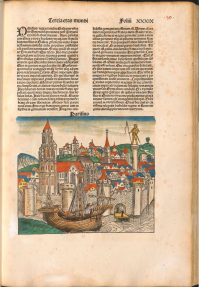
Paris from Hartmann Schedel's copy of the Latin edition of Nuremberg Chronicle in the Bayerische Staatsbibliothek.
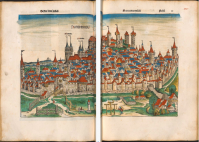
Double-page woodcut of Nuremberg in Hartmann Schedel's hand-colored copy of The Nuremberg Chronicle in the Bayerische Staatsbibiliothek.
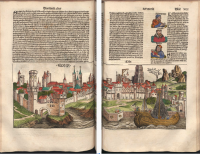
Double-page hand-colored woodcut of Cologne in the German edition of the Nuremberg Chronicle from the Bayerische Staatsbibliothek.


A: Mitte, Nürnberg, Bayern, Germany
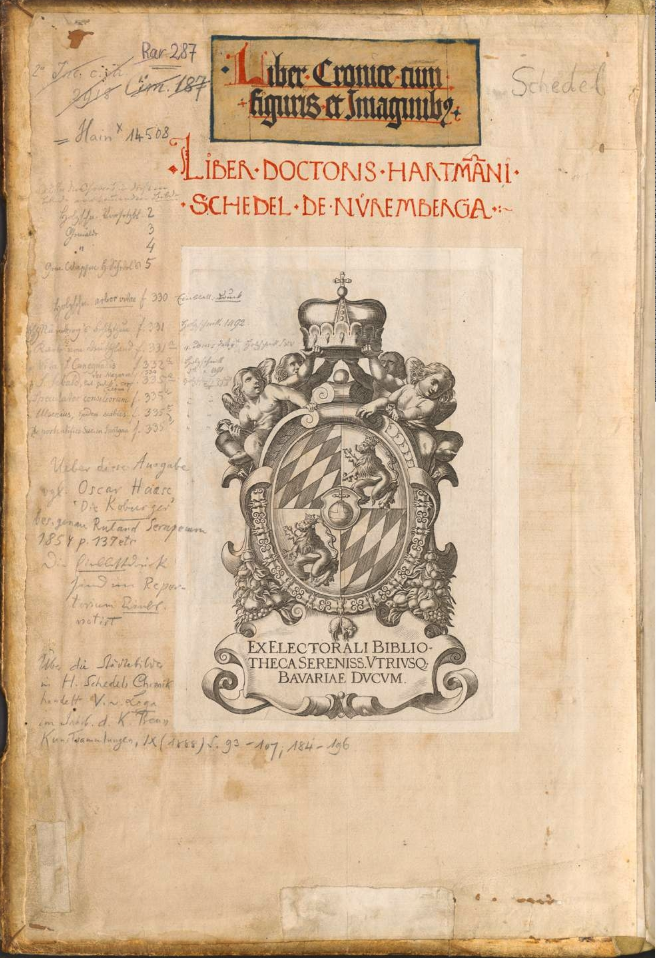
Hartmann's Schedel's ownership inscription in his personal copy of the Latin edition of the Nuremberg Chronicle, as preserved in the Bayerische Staatsbibliothek.
June 12, 1493 printer Anton Koberger of Nuremberg completed the printing and issued the Liber chronicarum written by physician Hartmann Schedel. A large-folio compendium of history, geography and natural wonders, the Liber chronicarum contained 298 printed leaves, including 1,809 illustrations from 645 woodcuts by or after painter and woodengraver Michael Wohlgemut (Wohlgemuth), his stepson Wilhelm Plydenwurff, and possibly some by Koberger's godson, the young Albrecht Dürer, who was apprenticed to Wohlgemut until 1490. Certain woodcuts were reproduced more than once, sometimes for the depiction of different people or cities. The images included a full-sheet map of Europe, a Ptolemaean world map, large and small city views, biblical and historical scenes, and portraits. A facsimile of the author, Hartmann Schedel's copy, is available from the Bayerische Staatsbibliothek at this link.
"From the outset, however, a German-language version had been planned. Translated by Georg Alt (c. 1450-1510), the city treasurer of Nuremberg, who assisted Schedel in compiling the Latin edition, the German edition was published on December 23, 1493. In addition to cosmetic differences (e.g., the Latin edition was printed using a typeface known as Antiqua Rotunda, while the German employed Bastarda Schwabacher), the German edition is very slightly abridged, with omissions that include certain abstruse thoughts as well as seeming repetitions. Occasionally, however, the German Chronicle includes minor but telling expansions on the Latin text. For example, in the Latin version one is told that a certain idea "can be found in Ovid" (folio IIr); the German version, however, informs its readers that this same idea "was elegantly expressed by Ovid, a poet." Such differences point to slightly different readerships: the Latin was aimed at the imperial, theological, and academic markets; the German at the upper middle class who did not possess a university education. Scholars estimate that approximately 1400-1500 Latin copies and 700-1000 German ones were printed. " (http://www.beloit.edu/nuremberg/inside/about/editions.htm, accessed 11-06-2012).
Though the information in the Nuremberg Chronicle was rapidly superceded, it remained famous for its extraordinary graphic design, its printing, its woodcuts and descriptions of cities. One of the woodcuts depicted the paper mill established in Nuremberg by Ulman Stromer in 1390. Probably because it was such a large and impressive volume, the work was a great commercial success, with unusually large printings for a fifteenth century book:
"The Latin edition was printed in at least 1400 copies, of which more than 1200 still exist today" (Wagner, Als die Lettern laufen lernten. Medienwandel im 15. Jahrhundert [2009] no. 11 (describing the annotated copy of the author, Hartmann Schedel, which is preserved at the Bayerischen Staatsbibliothek, Munich).
Most probably fewer copies of the German edition were printed, as it remains rarer on the market. Between roughly 1980 and 2009 there were 188 auction sales recorded for the Latin edition and 35 sales of the German edition, some sales presumably representing the same copies being resold.
In order to print and sell so many copies of an expensive book in the fifteenth century the printer Anton Koberger had to employ a geographically wide network of partners and sales agents.
"A revealing indication of the extent of Koberger's business is provided by a document of 1509, drawn up as a final settlement of the contract between partners involved in the production and sale of the Nuremberg Chronicle. This accounting reveals a network of outlets spread far and wide throughout Europe. We know that the Nuremberg Chronicle sold well, because there are at least 1,200 surviving copies logged in libraries today. But in 1509 there were still 600 copies unsold. For copies previously supplied debts were logged against the accounts of booksellers spread through the Germanic world: at Lübeck and Danzig, Passau and Vienna, Ingoldstadt, Augsburg and Munich. Linhard Tascher still had to settle for just over a hundred copies sent to him at Posen and Breslau (presumably for sale in Silesia); eighty-three Latin and twenty-eight German. A separate consignment of mostly Latin copies had been dispatched to Cracow. The Koberger agency in Lyon had to account for forty-one copies, and several hundred had been dispatched to agents in Italy, at Bologna, Florence and Genoa. Peter Vischer, the agent at Milan, had received the largest consignment for distribution in the peninsula, of which almost 200 remained unsold. The Venice agent, Anthoni Kolb, had just thirty-four left. Bearing in mind that these represent the unsold residue of what had been a very large edition, the geographical reach of Koberger's enterprise was every bit as impressive as the Venetian network of the previous decades. The bold confidence with which Koberger had taken on the Italian market was especially striking, even if transalpine demand for this masterpiece of German typography had ultimately not matched expectations" (Pettegree, The Book in the Renaissance [2010] 77-78).
Remarkably, the original manuscript exemplars showing the exact arrangement of the text and illustrations for both the Latin and German editions, as well has other original documents pertaining to the publication of these works, were preserved. The exemplar for the Latin edition is in the Stadbibliothek Nürnberg. The exemplar for the German edition is in the Nuremberg City Library. Adrian Wilson, a book designer and historian of book design from San Francisco, issued an outstanding book in which he showed the relationship between these manuscript exemplars and the printed editions: The Making of the Nuremberg Chronicle (1976).
Perhaps in 1941 an English translation of the Nuremberg Chronicle was prepared by Walter W. Schmauch of Chicago. This existed as a typescript for many years, preserved in the Rare Book Department of the Free Library of Philadelphia. The title page of the translation, of which I obtained a complete xerographic copy decades ago, reads: First English Edition of the Nuremberg Chronicle. Being the Liber Chronicarum of Dr. Hartmann Schedel, A. D. 1493. Translated from the First German Edition by Walter W. Schmauch of Chicago with Text Annotations and Woodcut Elucidations in Six Volumes. The translation extends to at least 2000 pages of typescript. In 2003 Beloit College in Beloit, Wisconsin, and the University of Wisconsin collaborated on publishing Schmauch's entire translation online; in September 2020 it was available at this link.
ISTC no. is00307000 (Latin). ISTC no. is00309000 (German). Both of these entries provide censuses of the many institutions that hold copies of the respective editions.

