 Jeremy Norman’s
HistoryofInformation.com Exploring the History of Information and Media through Timelines
Jeremy Norman’s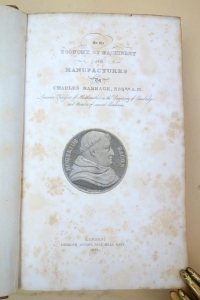
Title page of the first edition. The paper used for the title pages of all the early edition of this book was thicker and more inclined to foxing than the text, which is almost invariably free of foxing.


A: London, England, United Kingdom
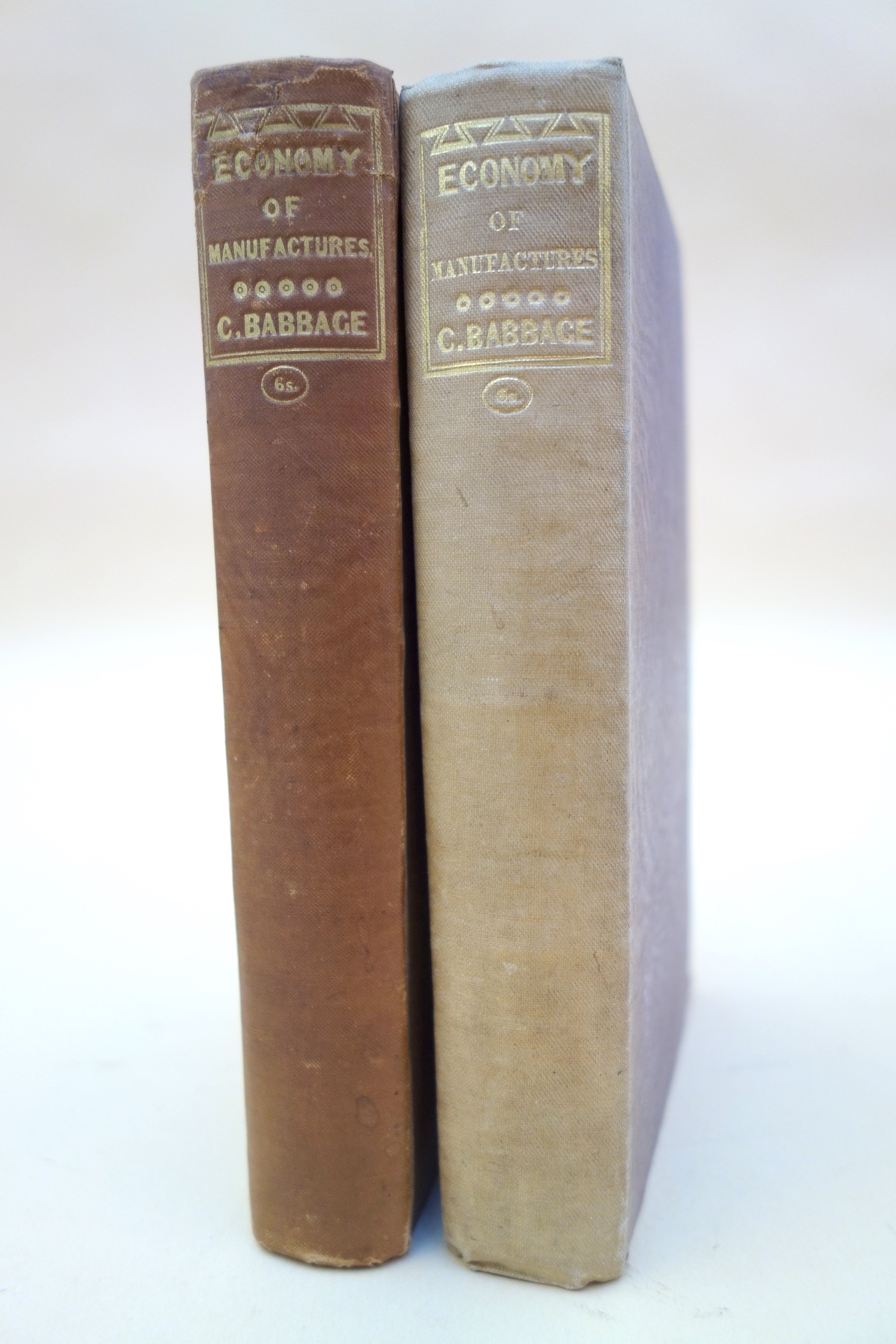
The decorated spines of the first and third editions of Babbage's book, both of which were issued in 1832. The spine of the first edition (left) is one of the earliest edition bindings in which the gilt decoration was stamped directly into the cloth. The price of 6 shillings stamped into the spines under the title was a Charles Knight innovation; this was probably the first time it was done. Like the bindings on John Murray's edition of Byron, these bindings, with relatively small stamping on the spines were probably among the first bindings produced with the newly invented Imperial Arming Press. Within a short time binders increased the sizes of the stamping, covering more the spines and also stamping on the upper and lower covers.
In 1832 Charles Babbage published On the Economy of Machinery and Manufactures, the first work on operations research, partially based on data he had accumulated during the previous ten years in order to build his Difference Engine No. 1. Primary themes of the book were the division of labor and the division of mental labor, to which Babbage devoted chapters 19 and 20. The first part of his chapter on the division of mental labor was an analysis of the methods used by de Prony in the production of his celebrated mathematical tables, and the third and fourth editions included in section 249 a small table calculated by the completed portion of the Difference Engine No. 1.
Babbage had seen de Prony’s manuscript tables in 1819, and around 1820 began planning the Difference Engine No. 1 based on the principles of the division of labor. With this goal, Babbage visited factories throughout England, inspecting every machine and every industrial process. Rather than a study limited to engineering and manufacturing techniques, his book turned out to be an analysis of manufacturing processes within their economic context. Written when manufacturing was undergoing rapid development and radical change, the book represented an original contribution to British economics.
"Adam Smith had never really abandoned the belief, reasonable enough in his day, that agriculture was the principal source of Britain’s wealth; Ricardo’s ideas were focused on corn; Babbage for the first time authoritatively placed the factory in the centre of the stage. The book is at once a hymn to the machine, and analysis of the development of machine-based production in the factory, and a discussion of social relations in industry. . . .
"The Economy of Manufactures established Babbage’s position as a political economist and its influence is well attested, particularly on John Stuart Mill and Karl Marx. Babbage’s pioneering discussion of the effect of technical development on the size of industrial organizations was followed by Mill and the prediction of the continuing increase in the size of factories, often cited as one of Marx’s successful economic predictions, in fact derives from Babbage’s analysis. . . . Babbage wrote with many talents: a natural philosopher and mechanical engineer, his knowledge of factory and workshop practice was encyclopaedic; he was well-versed in relevant business practice; and he was without rival as a mathematician among contemporary British political economists" (Hyman, Charles Babbage, Pioneer of the Computer (1982) 103–4).
Related to what would become the new field of operations research, Babbage discussed topics like the regulation of power, control of raw materials, division of labor, time studies, the advantage of size in manufacturing, inventory control, and duration and replacement of machinery. Besides regular pagination and chapters Babbage divided his book into numbered sections, which reached No. 467 by the third and fourth edition (1835), though the Table of Contents extended only to section No. 463. The book was indexed to the section numbers rather than to pages.
In Chapter XI, "Of Copying", Babbage analyzed a surprisingly wide range of methods of duplication, including many different kinds of printing of different products, only a few categories of which were printing on paper. In section 159 he broke down the process of preparing the stereotype plates, on which his book was printed, into six different stages, and in Chapter XXI, "On the Cost of Each Separate Process in a Manufacture", section 256, he presented an exceptionally detailed accounting of all the costs in the production of the 3000 copies of the first edition of his book, which presumably he paid, followed by analyses of these costs in sections 257-262, the costs not including the extra charges for the small number of large paper copies (222 x 142mm) which Babbage ordered for presentation to his friends. Among the details mentioned in section 256 was that the book was printed on large sheets with 16 pages up, resulting in gatherings of 32 pages. As the book was printed sheets larger than could be printed on a hand press, and from stereotype plates, we may thus assume that the book was printed by machine, especially as its publisher Charles Knight was an early exponent of machine printing and its cost efficiencies. Though Babbage does not discuss the gold-stamped cloth publisher's bindings in which most of edition appeared, these were very early gold-stamped cloth edition bindings, produced during the first year in which the technology existed for stamping gold directly into cloth. The stamping of the selling price (6s) beneath the spine title was a Charles Knight innovation that probably first occurred with this binding. That three different editions of the book were issued during 1832, all of which appeared in publisher's cloth bindings, confirms that these bindings--especially those on the first and second editions which were sold out in 1832-- were actually put on during the year 1832.
Hook & Norman, Origins of Cyberspace (2002) No. 42.