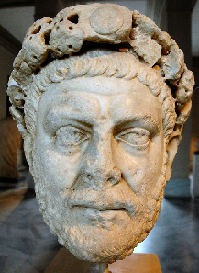
Bust of Diocletian, Roman emperor at the end of the third century AD. In 301, in an effort to control inflation, he implemented the Edict on Maximum Prices.
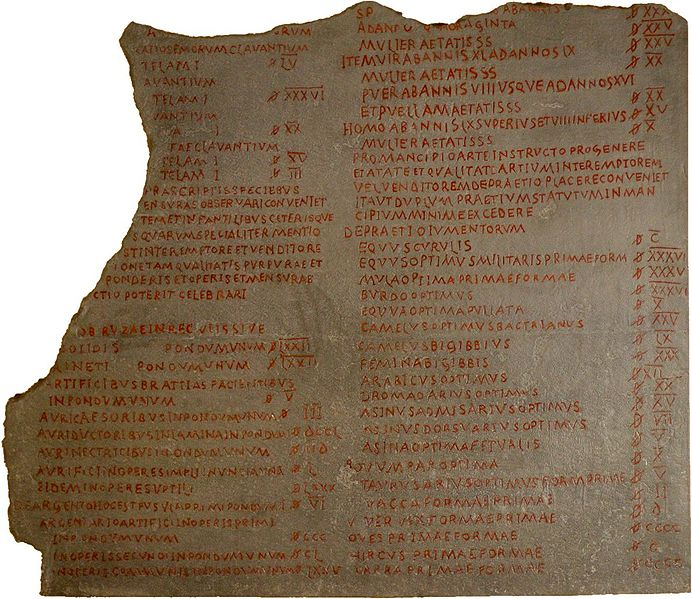
"At the time of the conversion to Christianity, Rome had twenty-eight libraries within its walls and book production was so well established a line of business that Diocletian, in his price edict [Edict on Maximum Prices (also known as the Edict on Prices or the Edict of Diocletian; in Latin Edictum De Pretiis Rerum Venalium)] set rates for various qualities of script: for one hundred lines in 'scriptura optima', twenty-five denarii; for somewhat lesser script, twenty denarii, and for functional script ('scriptura libelii bel tabularum'), ten denarii. The unit of valuation was the normal length of line in a verse of Virgil [Vergil]. The extent of a work is given in these units at the end of some manuscripts (stichometry), and stichometric lists survive for biblical books and for the writings of Cyprian" (Bischoff, Latin Palaeography: Antiquity and the Middle Ages [1990] 182).
Laufer, Diokletians Preisedikt (1971).
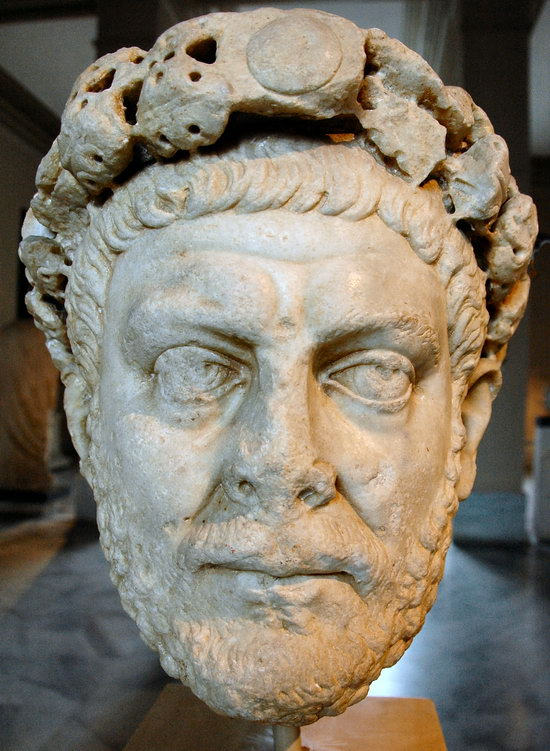
Bust of Diocletian, Roman emperor at the end of the third century AD. In 301, in an effort to control inflation, he implemented the Edict on Maximum Prices.