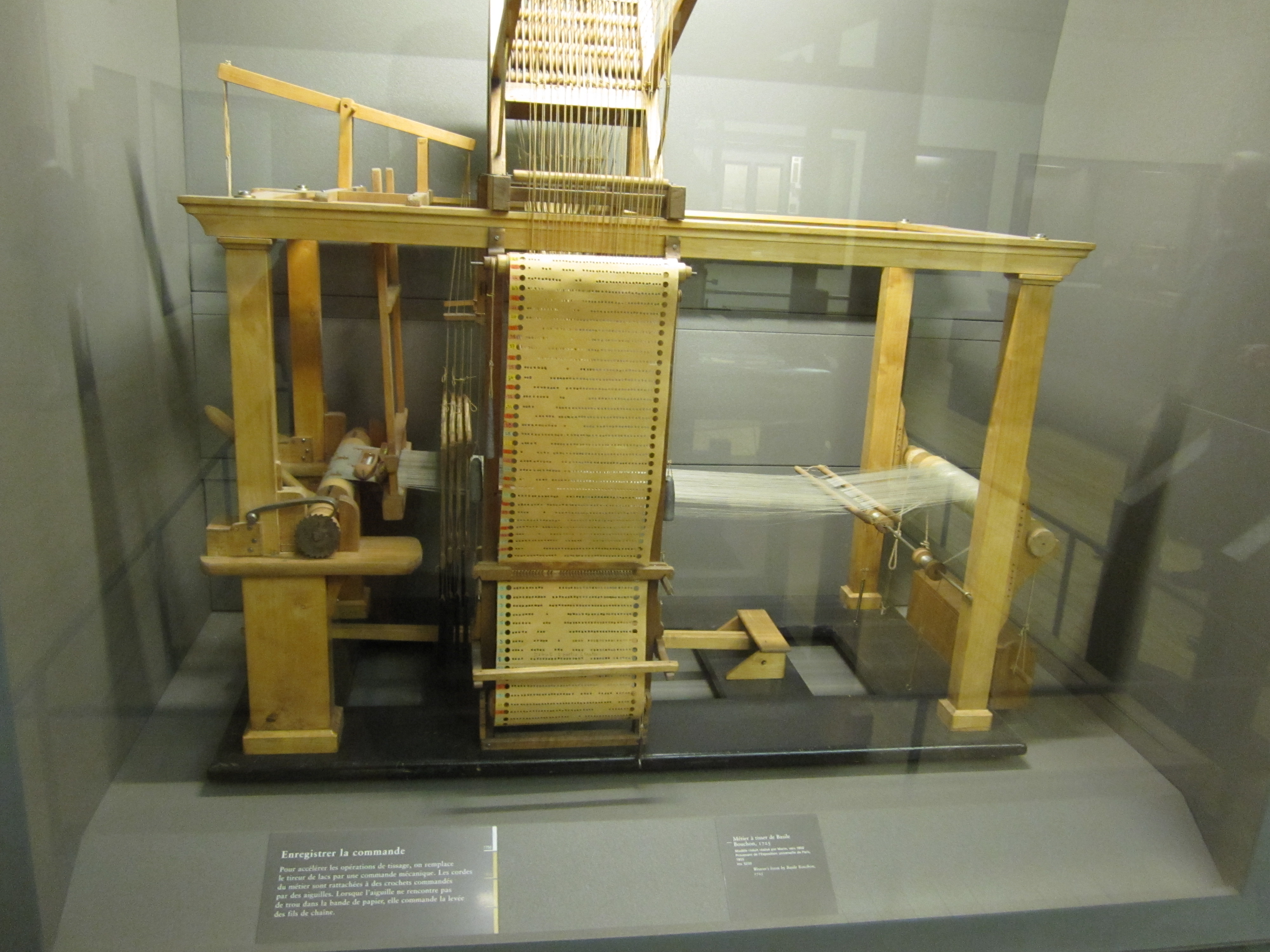
Basile Bouchon 1725 loom on display at the Musée des Arts et Métiers, Paris.
In 1725 Basile Bouchon of Lyon, the son of an organ maker, adapted the concept of musical automata controlled by pegged cylinders to the repetitive task of weaving. He invented a loom that was controlled by perforated paper tape. Bouchon's invention was the first industrial application of a semi-automated machine.
In order to make the input of instructions to the loom more flexible, in 1728 Jean-Baptiste Falcon substituted a chain of punched paper cards for the perforated paper tape employed by his colleague Basile Bouchon. Other inventors also contributed to the automation of weaving: Regnier and Vaucanson; however, none of the attempts before Jacquard were totally successful.