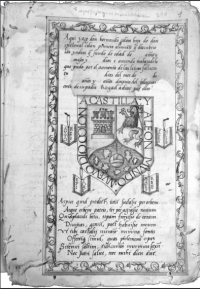
Hernando Colón’s coat of arms included in his will features the four inventories of his library: Autores, Sciencie, Materee, Epitome. The digital facsimile of Colón’s testament may be consulted on the web portal of the Archivo Histórico Provincial de Sevilla.
In 2013 Guy Laure of the University of Windsor identified Ferdinand Columbus's (Hernando Colón's) Libro de los Epítomes in the Arnamagæan Manuscript Collection (Den Arnamagnæanske Håndskriftsamling) at the University of Copenhagen. The manuscript volume, which consists of 982 leaves, contains close to 2000 summaries of the contents of books in Columbus's library in Seville that once contained about 15,000 volumes. To create the Libro de los Epítomes, Columbus employed a team of readers and writers to prepare a summary of each book in his library. Due to its extensive cross-referencing the Epítome has been compared to an early type of search engine.
"In addition to keeping a register of accessions, Colón had conceived four types of inventories to keep track of his books: a list of authors, a list of sciences (that is, subjects), a list of materials (that is, themes or keywords) and finally a list of epitomes, which contained detailed summaries of the contents of each of the books in the collection. All of these inventories could be cross referenced through numbers assigned to the books in each of the lists" (https://manuscript.ku.dk/motm/hernando-colons-book-of-books/).
According to Edward Wilson-Lee, author of The Catalogue of Shipwrecked Books: Young Columbus and the Quest for a Universal Library, discovery of Columbus's Epítome is "of immense importance, not only because it contains so much information about how people read 500 years ago, but also, because it contains summaries of books that no longer exist, lost in every other form than these summaries."

Hernando Colón’s coat of arms included in his will features the four inventories of his library: Autores, Sciencie, Materee, Epitome. The digital facsimile of Colón’s testament may be consulted on the web portal of the Archivo Histórico Provincial de Sevilla.