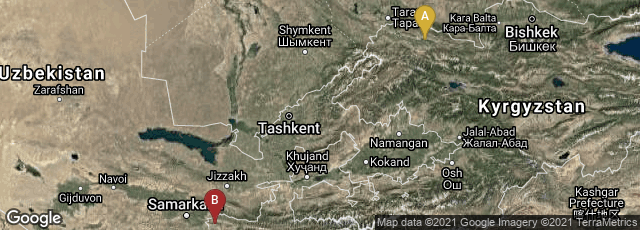
Traditionally scholars believed that Chinese prisoners of war taken at the battle of Talas conveyed papermaking techniques to the Arabs.
"According to Jonathan Bloom – a scholar of Islamic and Asian Art with a focus on paper and printing, the connection between Chinese prisoners and the introduction of paper in Central Asia is "unlikely to be factual". Archaeological evidence shows that paper was already known and used in Samarkand decades before 751 CE. Seventy-six texts in
Sogdian,
Arabic, and
Chinese have also been found near
Panjakent, likely predating the
Muslim conquest of Transoxiana. Bloom argues that based on differences in Chinese and Central Asian papermaking techniques and materials, the story of Chinese papermakers directly introducing paper to Central Asia is probably metaphorical. Chinese paper was mostly made of bast fibers while Islamic paper was primarily made of waste material like rags.
[26][27] The paper-making innovations in Central Asia may be pre-Islamic, probably aided by the Buddhist merchants and monks of China and Central Asia. The Islamic civilization helped spread paper and paper-making into the Middle East after the 8th-century, from where it arrived into Europe centuries later, and then to many other parts of the world. A historical remnant of this legacy is the continued use of the word "ream" to count bundles of paper, a word derived from Arabic
rizma (bundle, bale).
[26] (Wikipedia article on History of Paper, accessed 9-2020).