In 1931 Comte
Henri Bégouën and James Townsend Russell discovered a seashell at the entrance of the cave of
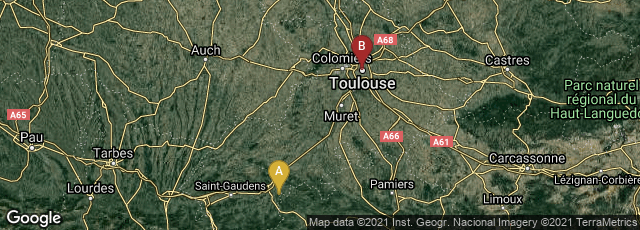
Marsoulas in the Haute-Garonne, France. This discovery was in addition to cave paintings discovered in the cave. They regarded the discovery as "exceptional," and interpretted the shell as a "loving cup"; the shell was preserved in the Natural History Museum of Toulouse. More than eighty years later scientists re-examined the shell and eventually drew the conclusion that the shell had been fashioned into a musical instrument by the prehistoric residents of the cave circa 17,000 years before present.
On February 10, 2021 C. Fritz, G. Tosello, G. Fleury and other scientists mainly from the Université de Toulouse confirmed that the shell was a musical instrument and succeeded in having three notes played by blowing through the shell. Their paper was "
First record of the sound produced by the oldest Upper Paleolithic seashell horn,"
Science Advances,
7, no. 7, DOI: 10.1126/sciadv.abe9510.
Also on February 10, 2021 Katherine Kornei reported on this discovery in
The New York Times in an article entitled "
Hear the Sound of a Seashell Horn Found in an Ancient French Cave." The article incorporated a 12 second digital recording of the three notes from the horn as played by a musician. The notes were similar to C, C-sharp, and D. Another feature of the shell was that it contained vestiges of red pigment similar to the dots used to form a bison silhouette in the cave.
"Dr. Fritz and her colleagues started by assembling a three-dimensional digital model of the conch. They immediately noticed that some parts of its shell looked peculiar. For starters, a portion of its outer lip had been chipped away. That left behind a smooth edge, quite unlike Charonia lampas, said Gilles Tosello, a prehistorian and visual artist also at the University of Toulouse. “Normally, they’re very irregular.”
"The apex of the conch was also broken off, the team found. That’s the most robust part of the shell, and it’s unlikely that such a fracture would have occurred naturally. Indeed, further analysis showed that the shell had been struck repeatedly — and precisely — near its apex. The researchers also noted a brown residue, perhaps remnants of clay or beeswax, around the broken apex.
"The mystery deepened when the team used CT scans and a tiny medical camera to examine the inside of the conch. They found a hole, roughly half an inch in diameter, that ran inward from the broken apex and pierced the shell’s interior structure.
"All of these modifications were intentional, the researchers believe. The smoothed outer lip would have made the conch easier to hold, and the broken apex and adjacent hole would have allowed a mouthpiece — possibly the hollow bone of a bird — to be inserted into the shell. The result was a musical instrument...." (New York Times).